
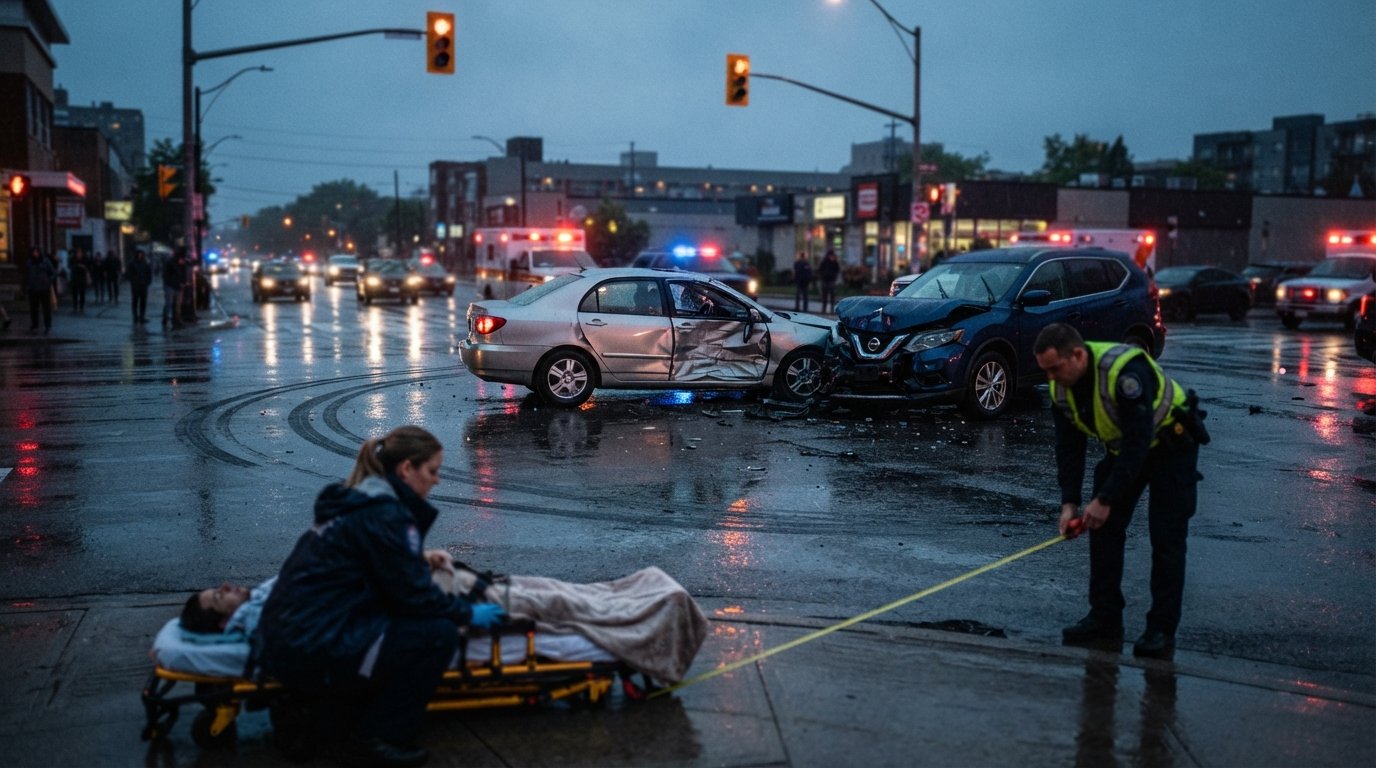
Partial Fault in Car Accident: Shared Negligence and Claims
Partial fault in car accident how shared negligence affects claims explained. Call (833)-349-4659 to protect your recovery and challenge unfair fault percentages.

By Adrian Brooks
You are sitting at a green light, waiting to turn left. A car runs the red light and slams into your passenger side. Your neck snaps forward, your car spins, and the next thing you know, you are in an ambulance. Weeks later, the other driver's insurance company calls and says they are only paying 70 percent of your medical bills because you "should have seen them coming." Suddenly, the question of partial fault in a car accident and how shared negligence affects claims becomes the most important legal issue in your life.
Shared fault, also called comparative negligence or contributory negligence, is the legal principle that determines how much money you can recover when more than one person contributed to an accident. Nearly every state uses some version of this rule, but the details vary dramatically. In some states, being 1 percent at fault reduces your recovery by 1 percent. In others, being 51 percent at fault wipes out your claim entirely. Understanding where your case falls on that spectrum is the difference between a fair settlement and a financial disaster.
This article breaks down how partial fault works in car accident claims, how insurers assign blame, what evidence counters a shared-fault allegation, and why the specific jurisdiction where your crash happened matters more than almost anything else. If you have been injured and the other side is pointing a finger at you, this information will help you protect your rights and make informed decisions about your next steps.
What Is Partial Fault and Why Does It Matter?
Partial fault means that more than one party shares responsibility for causing a car accident. Maybe you were speeding slightly, but the other driver ran a stop sign. Maybe you failed to signal a lane change, but the other driver was texting. In legal terms, this is called comparative negligence, and it directly reduces the amount of compensation you can recover from the other party.
Imagine a crash where a jury determines the total damages are $100,000. If you are found 20 percent at fault, you can recover $80,000 from the other driver. That 20 percent reduction represents $20,000 that comes directly out of your pocket. In a serious injury case with hundreds of thousands of dollars in medical bills and lost wages, even a small percentage of fault can mean tens of thousands of dollars in lost compensation.
Insurance adjusters know this. They also know that most people do not understand the nuances of comparative negligence law. That knowledge gap gives them leverage. An adjuster might casually suggest you were partly responsible, hoping you will accept a lower settlement without questioning the math. Do not let that happen. The percentage of fault assigned to you is not a fact written in stone; it is a conclusion that can be challenged with the right evidence and legal strategy.
Pure Comparative vs. Modified Comparative Negligence: The Two Main Frameworks
States follow one of a few approaches to shared fault. The two most common are pure comparative negligence and modified comparative negligence. A small number of states (Alabama, Alaska, Maryland, North Carolina, Virginia, and the District of Columbia) still follow contributory negligence, a harsh rule that bars recovery entirely if you are even 1 percent at fault. Most states have moved away from that approach because it produces unfair results.
Under pure comparative negligence, you can recover damages no matter how much fault you share, though your recovery is reduced by your percentage of fault. If you are 90 percent at fault, you can still recover 10 percent of your damages. California, New York, Florida, and Washington are pure comparative states. This approach is the most forgiving for injured parties, but it still means that a high fault percentage severely limits what you receive.
Modified comparative negligence is more common. Under this framework, you can recover damages only if your fault is below a certain threshold, usually either 50 percent or 51 percent. If your fault exceeds that threshold, you recover nothing. States are split between the two variations:
- 50 percent bar states: You cannot recover if you are 50 percent or more at fault. Examples include Colorado, Georgia, and Idaho.
- 51 percent bar states: You can recover if you are 50 percent or less at fault, but not if you are 51 percent or more. Examples include Texas, Ohio, and Pennsylvania.
The difference between a 50 percent bar and a 51 percent bar seems trivial, but it can be decisive. Imagine you are found 50 percent at fault. In a 51 percent bar state like Texas, you can still recover half your damages. In a 50 percent bar state like Colorado, you recover nothing. That one percentage point determines whether you receive compensation or walk away empty-handed.
Because jurisdiction matters so much, any assessment of partial fault in a car accident and how shared negligence affects claims must start with the law of the state where the crash occurred. A lawyer licensed in that state will know the precise threshold and how local courts tend to apply it.
States That Bar Recovery When Fault Exceeds a Threshold
The states that bar recovery when fault exceeds a threshold are the modified comparative negligence states. In these jurisdictions, the threshold acts as a cliff: cross it, and your claim disappears. This is why insurance adjusters in those states often work hard to push your fault percentage just above the line, even if the evidence does not support it.
Consider a Texas crash where the other driver rear-ended you, but you had a broken taillight. The adjuster might argue that your broken taillight contributed 55 percent to the accident because the other driver could not see you braking. If a jury accepts that argument, you recover nothing under Texas's 51 percent bar. But if your attorney successfully argues that the broken taillight played only a minor role, perhaps 10 percent, you recover 90 percent of your damages. The stakes are enormous.
In states with a 50 percent bar, the battle is even tighter. You need to keep your fault at 49 percent or lower. That often means presenting evidence that directly contradicts the adjuster's narrative. Police reports, witness statements, traffic camera footage, and accident reconstruction can all help shift the percentage in your favor.
Some states also have special rules for certain types of accidents. For example, in a rear-end collision, the rear driver is usually presumed at fault, but that presumption can be rebutted if the front driver stopped suddenly without warning. In a left-turn accident, the left-turning driver is often presumed at fault, but that presumption can be rebutted if the other driver was speeding or ran a red light. Knowing these presumptions helps you anticipate how fault will be assigned.
How Insurance Adjusters Assign Percentages of Fault
Insurance adjusters do not have a magic formula for assigning fault percentages. They rely on a combination of evidence, experience, and negotiation strategy. Most adjusters start by reviewing the police report, which often includes a preliminary fault determination. They also interview witnesses, review photographs of vehicle damage, and sometimes consult accident reconstruction experts.
But here is what many people do not realize: the adjuster's initial fault assessment is not legally binding. It is an opening position. Adjusters are trained to minimize payouts, and one of the easiest ways to do that is to assign you a percentage of fault. Even if the police report clearly blames the other driver, the adjuster might still argue that you contributed somehow, perhaps by speeding, failing to keep a proper lookout, or not wearing a seatbelt (though seatbelt use is not admissible in some states).
Adjusters also consider the relative severity of each party's negligence. If the other driver was drunk and ran a red light, while you were driving 5 mph over the speed limit, your fault percentage should be very low. But if both parties were engaging in risky behavior, the percentages might be closer to equal. The adjuster's goal is to find any reason to reduce your payout, so they will scrutinize every detail of your driving behavior in the moments before the crash.
You can push back. If the adjuster claims you were 30 percent at fault, ask for the specific evidence supporting that number. Often, the evidence is thin or nonexistent. A skilled attorney can challenge the adjuster's assumptions and present a more accurate picture of what happened. Sometimes, simply demanding justification for the fault percentage is enough to make the adjuster back down.
If you are dealing with a stubborn insurer or a complex fault dispute, professional guidance can make a significant difference. Platforms like AttorneyLawsuit provide resources for consumers researching legal disputes, including issues involving attorney conduct and fee disputes, which can be valuable if you suspect your own lawyer is not advocating properly for your fault percentage.
What Evidence Helps Counter a Shared-Fault Allegation?
Countering a shared-fault allegation requires evidence that directly contradicts the other side's version of events. The strongest evidence is usually objective and independent: traffic camera footage, dashcam video, black box data from your vehicle, and eyewitness testimony from someone who is not affiliated with either driver.
Police reports are helpful but not definitive. Officers often make preliminary fault determinations based on limited information, and those determinations can be wrong. If the police report blames you, an attorney can introduce other evidence to show the officer misunderstood the facts. If the police report blames the other driver, that is helpful, but the adjuster may still argue that you share some fault.
Medical records and biomechanical evidence can also play a role. If the other side claims you were not wearing a seatbelt, your medical records might show seatbelt bruising patterns that prove you were. If they claim you were speeding, an accident reconstruction expert can analyze skid marks and vehicle damage to estimate your speed more accurately.
Witness statements are particularly valuable. A neutral witness who saw the other driver run a red light or swerve into your lane can be the difference between a 50 percent fault finding and a 10 percent fault finding. If you have witnesses, get their contact information immediately and ask them to write down what they saw while their memory is fresh.
Here is a practical checklist of evidence to gather after a crash where fault might be disputed:
- Photograph the scene, vehicle damage, and any visible injuries.
- Obtain the police report and review it for accuracy.
- Collect contact information for all witnesses.
- Preserve dashcam or surveillance footage before it is overwritten.
- Seek medical attention promptly and keep all records.
- Do not give a recorded statement to the other driver's insurer without legal advice.
Each piece of evidence helps build a narrative that reduces your fault percentage. The goal is not necessarily to prove you were perfect, but to show that your actions were not a substantial cause of the crash. Even a small reduction in your fault percentage can translate into thousands of dollars in additional compensation.
Why Jurisdiction Matters for a Case-Specific Assessment
Jurisdiction determines everything in a shared-fault case. The same facts can produce wildly different outcomes depending on which state's law applies. A crash that leaves you with zero recovery in a 50 percent bar state might yield a substantial settlement in a pure comparative state. That is why any meaningful assessment of partial fault in a car accident and how shared negligence affects claims must be tailored to the specific jurisdiction where the crash occurred.
Jurisdiction also affects procedural rules that influence fault allocation. Some states allow juries to assign fault to non-parties, such as a mechanic who failed to fix your brakes. Other states require that all potentially at-fault parties be named in the lawsuit. These procedural differences can change the strategic approach to your case.
If your accident happened in one state but you live in another, the choice of law can become complicated. Generally, the law of the state where the accident occurred governs the substantive fault rules. But insurance contracts and other factors can sometimes create exceptions. An attorney licensed in the accident state is best positioned to navigate these issues.
Because jurisdiction is so critical, you should be skeptical of any generic online calculator or chatbot that claims to estimate your fault percentage without knowing where the crash happened. A real assessment requires a lawyer who knows the local courts, the local judges, and the local insurance adjusters. That is why connecting with a qualified attorney early in the process is so important.
FormsByLawyers offers a no-cost, no-obligation case review that connects you with attorneys from its network. The platform uses a patented attorney selection process to identify top-tier legal professionals, and it provides tools like Quick Quotes and Customized Quotes to help you understand your options. While FormsByLawyers is not a law firm and does not provide legal advice, it can be a valuable starting point for finding a lawyer who understands the fault rules in your jurisdiction.
Practical Steps to Protect Your Claim When Fault Is Disputed
If you are facing a shared-fault allegation, the first thing to do is stop talking to the other driver's insurance company. Anything you say can be used to assign you a higher percentage of fault. You are not required to give a recorded statement, and you should decline politely if asked. Instead, direct the adjuster to your attorney.
Second, document everything. Keep a journal of your injuries, your medical treatments, your lost wages, and your pain levels. Take photos of your injuries as they heal. Save receipts for all accident-related expenses. This documentation supports your damages claim and shows that you are taking the case seriously.
Third, do not accept a quick settlement offer without legal review. Insurers often offer a low amount early, hoping you will sign away your rights before you realize the full extent of your injuries. Once you sign a release, you cannot go back for more money, even if your condition worsens. An attorney can evaluate whether the offer is fair given the fault allocation and your damages.
Fourth, be honest with your lawyer about your own actions. If you were speeding or distracted, tell your attorney. That information will come out eventually, and hiding it only hurts your case. A good lawyer can frame your actions in context and argue that they were not a substantial cause of the crash.
Finally, understand that fault allocation is often negotiable. Even if the police report assigns you some fault, that is not the final word. Through negotiation or litigation, your attorney can challenge the percentage and present evidence that supports a lower number. Many cases settle with a fault split that both sides can live with, but only if you have an advocate who knows how to push back.
If you are unsure where to start, consider reaching out to a legal professional who can provide a case-specific evaluation. The sooner you act, the better your chances of preserving evidence and building a strong claim.
Partial fault does not have to mean the end of your claim. With the right evidence and the right legal strategy, you can reduce your fault percentage and recover the compensation you deserve. The key is to understand the rules in your jurisdiction, avoid common mistakes, and get professional help when the stakes are high.