
How Is Fault Determined in a Multi Vehicle Car Accident?
Fault in a multi vehicle crash involves shared responsibility and evidence. Get clarity on comparative fault and protect your claim. Call (833)-349-4659 for a free review.

By Adrian Brooks
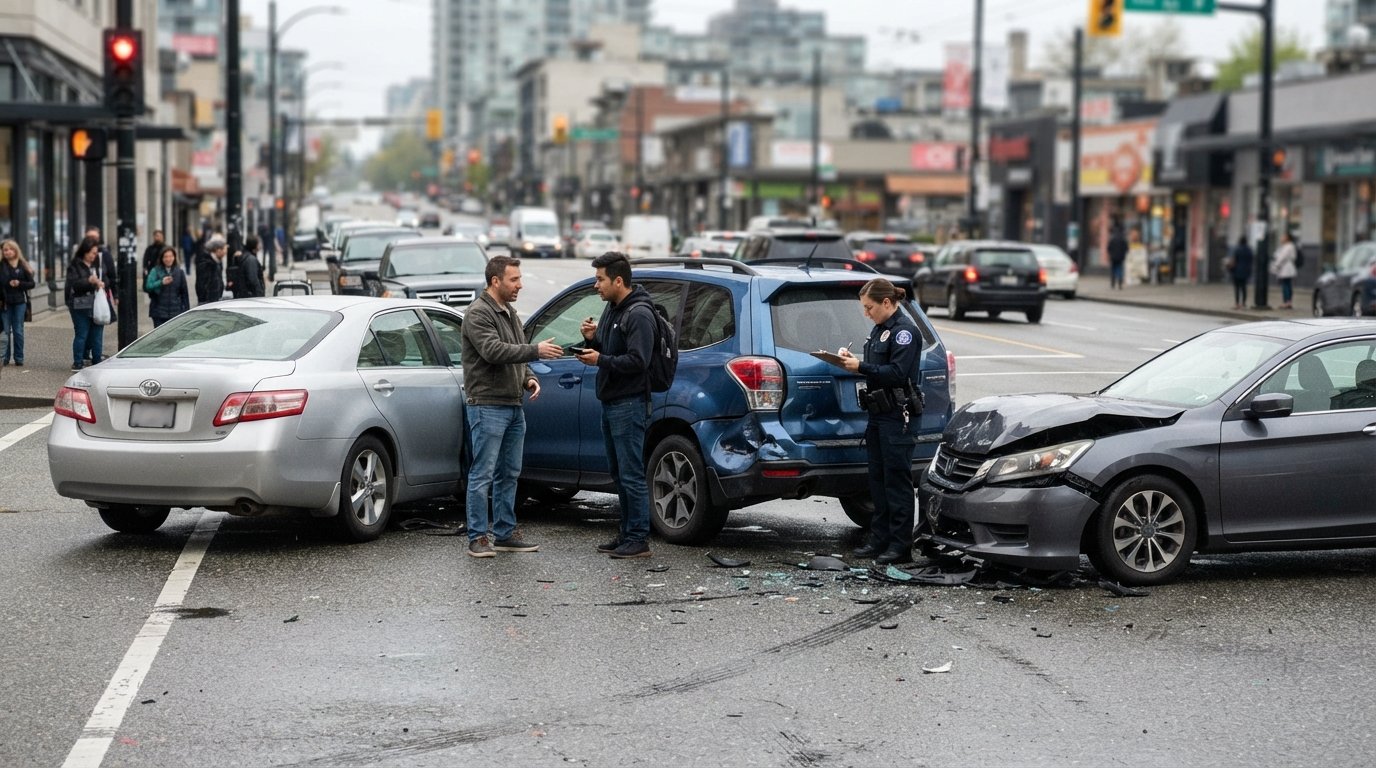
You are sitting at a red light when you feel a jolt from behind. Before you can process what happened, another impact pushes your car forward into the vehicle ahead. In seconds, three or more cars are tangled together, and everyone is looking at everyone else. In a multi vehicle car accident, the question of fault is rarely simple. Unlike a two car fender bender where blame often falls on one driver, a chain reaction crash can involve shared responsibility, disputed versions of events, and multiple insurance companies pointing fingers at each other. Understanding how fault is determined in a multi vehicle car accident is critical because it directly affects who pays for vehicle damage, medical bills, lost wages, and pain and suffering. The stakes are high, and the process is more complex than most drivers realize.
The Rear End Presumption and Its Impact on Middle Drivers
In many multi vehicle collisions, the first question investigators ask is who hit whom. The driver in the rear is often presumed to be at fault for a rear end collision. This presumption is based on the idea that a following driver must maintain a safe distance to stop in time. However, in a chain reaction crash, that presumption can be misleading, especially for the middle driver. Imagine three cars: Car A is stopped, Car B is stopped behind it, and Car C rear ends Car B, pushing it into Car A. At first glance, Car C seems responsible for both impacts. But what if Car B had been following Car A too closely and would have hit it anyway? Or what if Car B's brake lights were faulty? The middle driver may be blamed by the front driver and by the rear driver, each claiming the middle driver caused the chain.
Insurance adjusters and courts look beyond the rear end presumption by examining the sequence of impacts, the spacing between vehicles, and the reaction times of each driver. Event data recorders, often called black boxes, can show whether brakes were applied before or after a collision. Witness statements can clarify whether the middle driver was pushed or was already moving. For middle drivers, the rear end presumption is not a automatic loss. It is a starting point that can be rebutted with evidence. However, without that evidence, the middle driver may end up absorbing liability for both the front and rear impacts, which is why early investigation is so important.
Comparative Fault: How Percentages Reduce Recovery
Most states use a system of comparative fault, also called comparative negligence, to allocate responsibility in multi vehicle accidents. Under this system, each driver is assigned a percentage of fault, and their recovery is reduced by that percentage. For example, if you are awarded $100,000 in damages but found 30 percent at fault, you receive $70,000. Some states follow pure comparative fault, where you can recover even if you are 99 percent at fault, while others follow modified comparative fault, where you cannot recover if you are 50 or 51 percent at fault or more. In a multi vehicle crash, these percentages can become highly contested. Each driver's insurer will try to shift blame to others to minimize payout, and your own percentage can be inflated by aggressive adjusters.
Consider a four car pileup on a highway. The driver at the rear may claim the third driver cut them off, the third driver may claim the second driver brake checked, and the second driver may claim the first driver stopped suddenly without warning. The insurance companies will hire accident reconstruction experts to analyze skid marks, vehicle damage, and electronic data. The final fault allocation might be 50 percent to the rear driver, 30 percent to the third driver, and 20 percent to the second driver, with the first driver fault free. Your recovery depends on where you fall in that breakdown. If you are the second driver, a 20 percent fault assignment reduces your compensation by 20 percent. If you are in a modified comparative fault state and your fault reaches 50 percent, you might recover nothing. This is why challenging an unfair fault percentage is essential.
Evidence That Determines Fault: Police Reports, Event Data Recorders, and Witness Statements
In the aftermath of a multi vehicle accident, several types of evidence are used to determine fault. The police report is often the first document insurers review, but it is not the final word. Officers may not have witnessed the crash, and their opinions can be challenged. However, the report contains valuable details such as diagrams, witness names, and citations issued. Event data recorders, which are installed in most modern vehicles, capture speed, braking, steering, and seatbelt use in the seconds before impact. This data can be downloaded by investigators and can either support or contradict a driver's account. Witness statements from independent bystanders are also powerful, especially if they saw the sequence of events clearly.
Beyond these, other evidence includes photographs of vehicle damage (which can indicate impact speed and angle), surveillance video from nearby businesses or traffic cameras, and medical records that show injury patterns consistent with certain crash dynamics. In some cases, accident reconstruction experts use physics to calculate speeds and distances. For example, they can determine whether a middle vehicle was pushed into the car ahead or was already moving forward at the time of impact. All of this evidence comes together to create a fault narrative. The more evidence you have, the better your chances of avoiding an unfair blame allocation. In a multi vehicle crash, it is crucial to preserve evidence quickly, because event data recorders can be overwritten and witness memories fade.
Dealing With Multiple Insurers and Policy Limits
When multiple vehicles are involved, you may be dealing with several insurance companies, each representing a different driver. Each insurer has a duty to its own policyholder, not to you. They will investigate the accident, assign fault based on their own interests, and make settlement offers that minimize their payout. Coordinating claims with multiple insurers can be overwhelming. You might receive conflicting demands, requests for recorded statements, and lowball offers. One insurer might accept 100 percent fault while another denies any responsibility. In some cases, an insurer may try to settle with you quickly before you understand the full extent of your injuries.
Policy limits add another layer of complexity. Each driver carries a certain amount of liability coverage, and in a multi vehicle accident, the total damages can exceed those limits. If the at fault driver has minimum coverage, there may not be enough to compensate everyone. Uninsured and underinsured motorist coverage on your own policy may step in, but that also requires proving the other driver's fault. In multi party crashes, you may need to file claims against multiple policies, and the order in which claims are paid can affect your total recovery. An experienced attorney can help you navigate this maze, negotiate with all insurers, and identify all available sources of compensation. If you are considering legal help, you might wonder how car accident lawyers with no win no fee work, which can allow you to pursue a claim without upfront costs.
Why Early Legal Review Matters in Multi Party Crashes
In a multi vehicle accident, the initial hours and days are critical. Evidence can disappear, memories can fade, and insurers can move quickly to lock in a favorable fault narrative. An early legal review can preserve evidence, interview witnesses, and obtain the event data recorder data before it is overwritten. An attorney can also evaluate the police report for errors, coordinate with accident reconstruction experts, and communicate with all insurers on your behalf. Without legal representation, you may inadvertently say something that is used against you or accept a settlement that does not cover your future medical needs.
Moreover, multi vehicle crashes often involve complex legal issues such as joint and several liability, where one defendant can be held responsible for the entire judgment if others are insolvent. An attorney can explain how these rules apply in your state and protect your rights. If you are unsure where to turn, resources like AttorneyLawsuit offer general information on legal disputes and attorney-related matters, though they are not a substitute for personalized legal advice. The key is to act promptly. The sooner you involve a legal professional, the better your chances of a fair outcome. If you are in a multi vehicle accident, consider reaching out to a qualified attorney who can assess your case and guide you through the process.
In the end, fault in a multi vehicle car accident is determined through a combination of evidence, legal rules, and negotiation. It is rarely as simple as pointing to the driver in the rear. By understanding the rear end presumption, comparative fault, evidence collection, and insurance tactics, you can better protect your rights. And if the process feels overwhelming, remember that you do not have to face it alone. A skilled attorney can level the playing field and help you secure the compensation you deserve.