
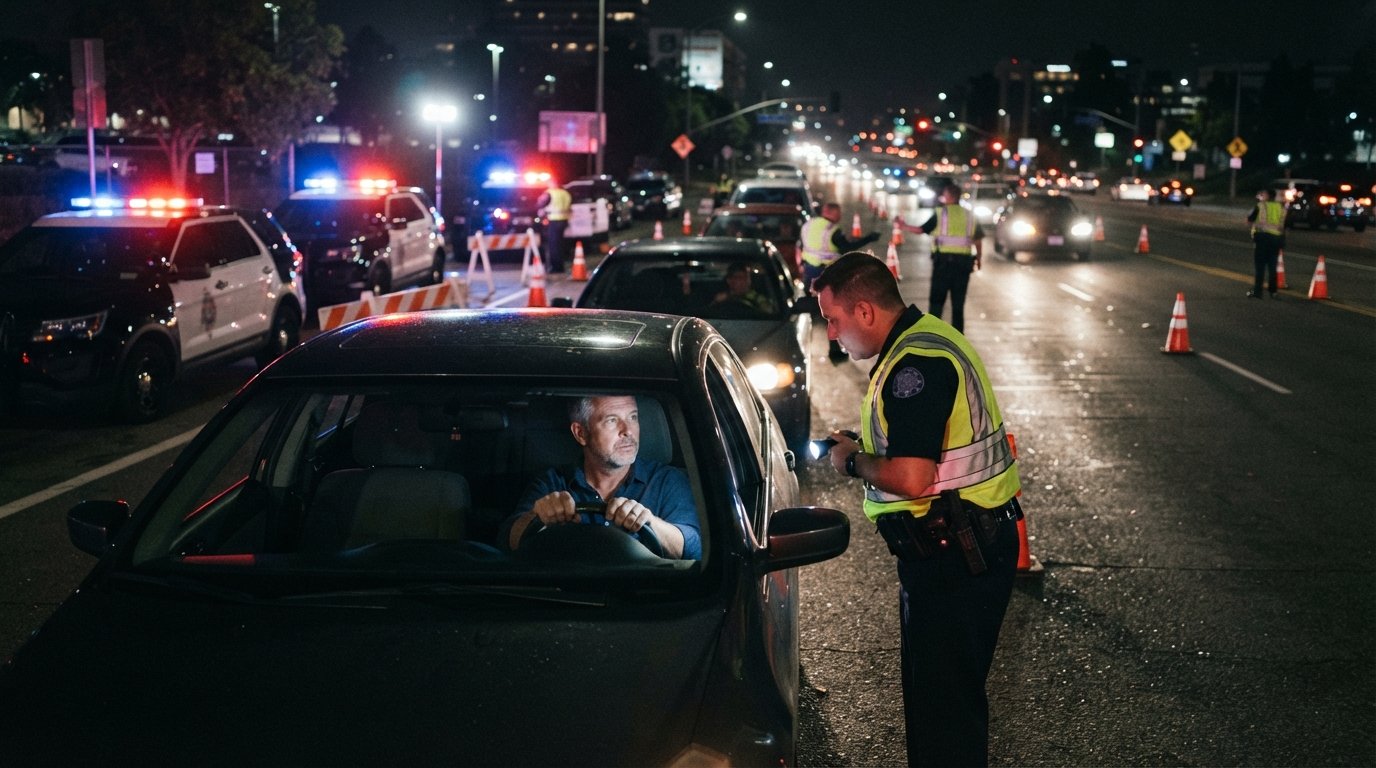
DUI Checkpoint Rights: What to Do When Stopped
Know your DUI checkpoint rights and what to do when stopped. Learn how to handle questions, tests, and implied consent laws to protect your record.

You see the flashing lights and the line of cars ahead. Your heart races. Even if you have had nothing to drink, a DUI checkpoint can feel intimidating. Knowing your rights and responsibilities before you reach the officer can turn a stressful encounter into a manageable one. This guide explains the legal landscape of sobriety checkpoints, what you must do, what you can refuse, and when to seek professional legal help. The information here is educational and not legal advice. For advice about your specific situation, consult a licensed DUI defense attorney.
Are DUI Checkpoints Legal? Understanding the Constitutional Framework
The Fourth Amendment to the U.S. Constitution protects citizens against unreasonable searches and seizures. A checkpoint stops every car without individualized suspicion, which seems to conflict with that protection. However, the U.S. Supreme Court addressed this tension in Michigan Department of State Police v. Sitz (1990). The Court held that sobriety checkpoints are constitutional if they are conducted according to neutral, standardized guidelines that minimize intrusion on drivers. The primary goal, the Court reasoned, is public safety, and the brief stop serves a compelling government interest.
Despite this ruling, not every state allows sobriety checkpoints. As of 2026, about a dozen states do not permit them, including Texas, Washington, Oregon, and Pennsylvania, among others. Some states allow them only under strict conditions, such as advance public notice and supervision by a ranking officer. If you are stopped at a checkpoint, the first question is whether the checkpoint itself is lawful under your state's rules. A local DUI attorney can evaluate whether the stop violated your rights. But for most drivers, the checkpoint is legal, and the focus should be on how to behave during the stop.
What to Do When You Approach a DUI Checkpoint: Step by Step
As you approach, slow down, stay calm, and follow the directions of law enforcement. Roll down your window, keep your hands visible on the steering wheel, and be polite. Remember that the officer is doing a job, and your demeanor can influence how the stop proceeds. Here is a practical sequence to follow.
- Slow down and obey instructions. Turn off your engine if asked, and avoid sudden movements. Keep your license and registration within reach, but do not reach for them until the officer asks.
- Provide identification and registration. You are generally required to show your driver's license, vehicle registration, and proof of insurance when requested. This is a legal obligation in most states.
- Answer basic questions carefully. The officer may ask where you are coming from or whether you have been drinking. You have the right to remain silent, but refusing to answer may prolong the stop. A common approach is to be cooperative but not to volunteer information. For example, you can say, "I prefer not to answer that question."
- Do not consent to a search. If the officer asks to search your vehicle, you can politely decline. Without consent or probable cause, the officer may not search. However, if the officer has probable cause (for example, seeing contraband in plain view), a search may proceed.
- Know your rights regarding field sobriety tests. In many states, you can refuse to perform standardized field sobriety tests (such as the walk-and-turn or one-leg stand) without immediate legal penalty, though the refusal may be used as evidence in a later proceeding. Refusing a preliminary breath test (PBT) at the roadside is also often allowed, but refusing a post-arrest chemical test (breath or blood) triggers implied consent penalties.
- Stay calm and document the encounter. If possible, note the officer's name and badge number, the time, and the location. This information can be valuable if you later challenge the stop.
After the stop, you may be waved through or asked to pull aside for further investigation. If you are asked to step out of the vehicle, comply. At that point, the officer may be developing probable cause for a DUI arrest. Your cooperation and calm demeanor can help avoid escalation, but you should not answer questions that could incriminate you without legal counsel.
Can You Refuse to Answer Questions or Take Field Sobriety Tests?
The Fifth Amendment protects you from being compelled to be a witness against yourself. At a checkpoint, you are not required to answer questions about how much you have had to drink or where you are coming from. However, refusing to answer may raise suspicion and lead to a longer detention. You can politely decline to answer incriminating questions. For example, you might say, "I prefer not to discuss that without a lawyer."
Field sobriety tests are a different matter. These tests (horizontal gaze nystagmus, walk-and-turn, one-leg stand) are voluntary in most states. You can refuse to perform them. However, the officer may consider your refusal as a factor in deciding whether to arrest you, and in some states, the refusal can be used against you at trial. Preliminary breath tests (handheld devices used at the roadside) are also generally voluntary, but refusing a PBT may not carry the same license penalties as refusing a post-arrest chemical test. The key distinction is between voluntary roadside tests and the mandatory chemical test after arrest.
In our guide on DUI expungement eligibility and record clearing, we explain how a DUI conviction can affect your record and what steps may be available to clear it. Understanding your rights at a checkpoint is the first step in protecting your future.
Implied Consent Laws and the Consequences of Refusing a Chemical Test
All states have implied consent laws. By driving on public roads, you automatically consent to chemical testing (breath, blood, or urine) if you are lawfully arrested for DUI. If you refuse a chemical test after arrest, you face administrative penalties from the DMV, such as license suspension, even if you are never convicted of DUI. The length of suspension varies by state and by whether it is a first or subsequent refusal. In many states, a first refusal leads to a one-year suspension; subsequent refusals can lead to longer suspensions or mandatory ignition interlock devices.
Refusing a chemical test does not prevent the officer from seeking a warrant for a blood draw. In recent years, courts have generally allowed officers to obtain search warrants for blood samples after a refusal, especially if there is probable cause. Therefore, refusing a test may delay the process but may not prevent it entirely. The decision to refuse is complex and should be made with the advice of counsel if possible. If you are arrested, you have the right to consult an attorney, though the timing of that consultation may be limited by the need to obtain a timely chemical test.
If you are facing a DUI charge, you may need to connect with a qualified attorney who understands local laws and can help you navigate the court process. CarInjuryAccident is a legal services platform that connects individuals with a team of seasoned attorneys specializing in personal injury, DUI, and other practice areas. You can request a free case review to discuss your options.
When to Contact a DUI Defense Attorney
You should consider contacting a DUI defense attorney as soon as possible after an arrest or if you believe your rights were violated at a checkpoint. An attorney can review the circumstances of the stop, including whether the checkpoint complied with state guidelines, whether the officer had probable cause, and whether your refusal to answer questions or take tests was handled properly. Early legal advice can help you understand deadlines for challenging your license suspension and build a defense strategy.
Even if you were not arrested, but you felt pressured or confused during a checkpoint, a consultation can clarify your rights. Many attorneys offer free or low-cost initial consultations. If you are unsure about how to find an attorney, FormsByLawyers offers a free case review tool that connects you with top-rated lawyers in your area. Their patented selection process identifies the top 5% of attorneys annually, so you can have confidence in the professional you choose.
Remember that this article provides general information and is not a substitute for legal advice. DUI laws vary significantly by state, and the facts of your case matter. For personalized guidance, speak with a licensed DUI defense attorney in your jurisdiction.
Being stopped at a DUI checkpoint does not have to be a frightening experience if you know your rights and obligations. Stay calm, be polite, provide required documents, and make informed decisions about answering questions and taking tests. If you face charges, seek legal help promptly to protect your rights and your future.